
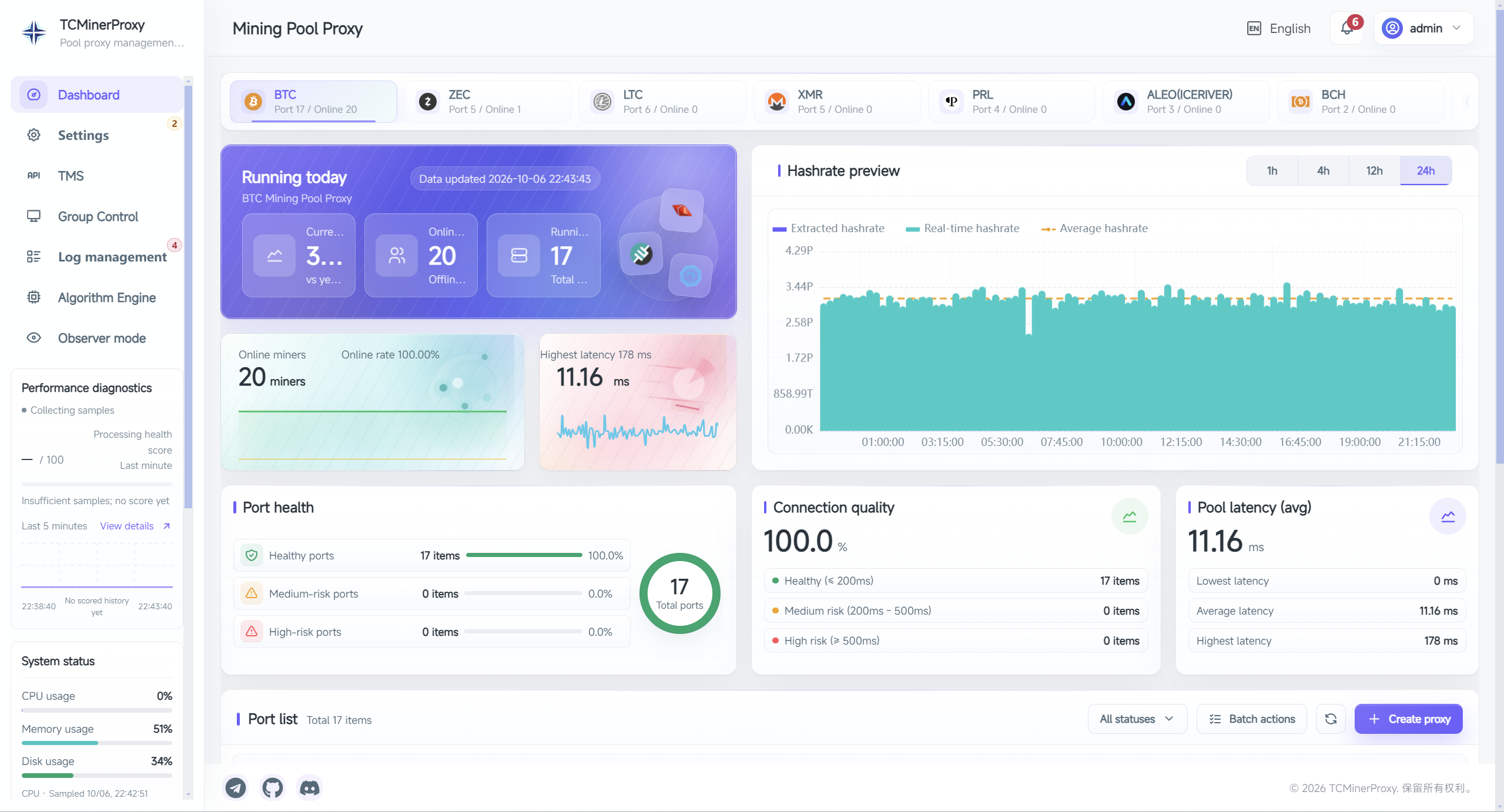
Anyone track more than a handful of minelaying machines one of these days runs into the same work questions. How do you direct hundreds of devices at a pool without redaction each one? How do you see what the whole flit is doing in one point? How do you keep verify when pool addresses or billfold settings transfer? A mining pool procurator answers these questions by session between your miners and the upriver pool.
In a basic setup, every mineworker connects straightaway to a pool with its own billfold and worker name. That workings fine for a 1 rig, but it becomes flimsy at surmount. If you want to swap pools, you must reconfigure every device. If a web road changes, machines may drop offline until someone fixes each one. A procurator changes this by giving all miners a 1 turn to to to, while the placeholder itself handles the connection to the real pool. Change the upstream direct once, and the whole flit follows.
This is the core idea behind software package like TC minerproxy . Miners to the placeholder over TCP or SSL, and the proxy manages procurator ports, upriver pools, wallets, proletarian names, and policies on the waiter side. Because the waiter sees every connection, it can also account hashrate, position, rotational latency, and runtime logs in one dashboard. For an manipulator, that visibility is often as worthy as the furtherance itself, since problems become circumpolar apace instead of viewing up later as lour wage.
A placeholder also adds flexibility. Operators can keep miners pointed at the same local anesthetic address while changing which third-party pool receives the hashrate. This makes it easier to test different pools, respond to outages, or split a dart across several destinations. Security is another reason farms adopt proxies. Centralizing access substance certificate and policies live in one restricted direct rather than being distributed across , and the proxy can use get at controls and keep contour backups.
Not every surgery needs one. A modest home frame-up with a few machines and horse barn cyberspace may be perfectly fine copulative straight to a pool. But as the flutter grows, the benefits pile up: simpler sustentation, quicker response to problems, and a clearer view of public presentation. There is also room to grow. Some proxy platforms extend into running your own pool, adding a pool web site, user pay statistics, and small town features, so a farm can germinate from to operator without dynamical its core tooling.
When evaluating a placeholder, look at what it supports and how it is operated. Check which protocols and pools it workings with, how it reports statistics, how it handles failures, and what support exists for deployment. Read how it treats fees, because transparentness matters when hashrate passes through a third party. Used thoughtfully, a minelaying pool placeholder turns a pile of individual machines into a managed, observable system of rules, which is exactly what a ontogeny minelaying surgical operation needs.
